Identity
Julia Chylak, Mateusz Błajda, Eryk Imos, Beata Bajno, Paulina Wachnicka
On The Existence of Self-Identity (2023) is an interactive installation that touches on the problem of the origin of our personality. In the past, most people adopted the beliefs and traditions of their fathers. However, with the increase in migration and the associated interactions between different cultures, many of us have started to ponder our own cultural identity. In
the era of globalization, cultures collide and blend. Interacting with those who hold different values offers a fresh perspective on our beliefs, paradoxically aiding in self-understanding like a mirror revealing what we have overlooked.
Is one’s self-identity a matter of choice or chance?
To what extent does experience shape our ego versus our inherent self?
If it is solely about exposure on data, what sets us apart from AI models?
How do politicians use technology and art to affect our way of thinking?
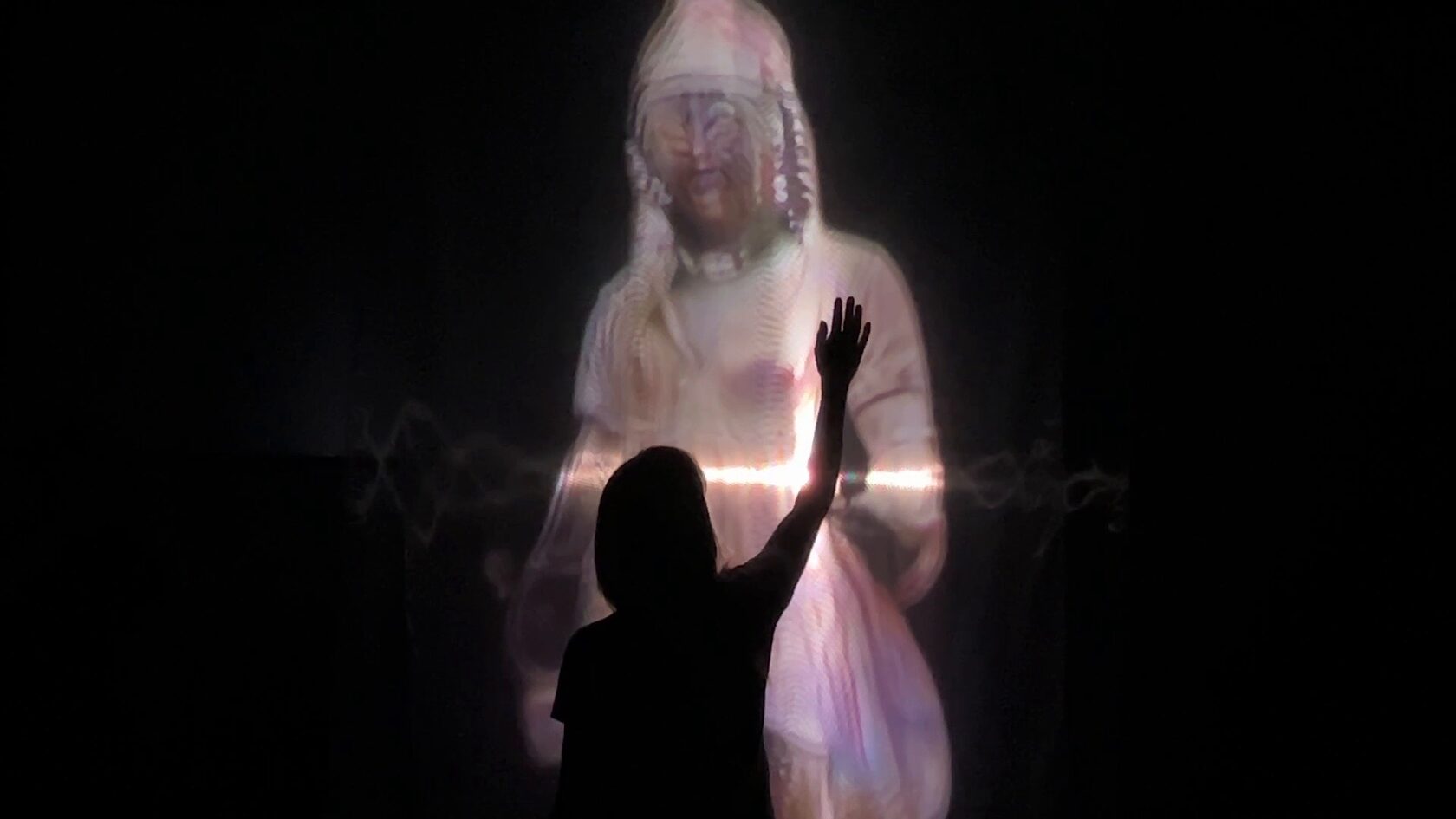
We enable every participant of our exhibition to consider these questions individually. Thus, we provide them an opportunity to talk to a projection of themselves, speaking in their own voice, underneath which is an AI endowed with knowledge gathered from philosophical and religious writings.
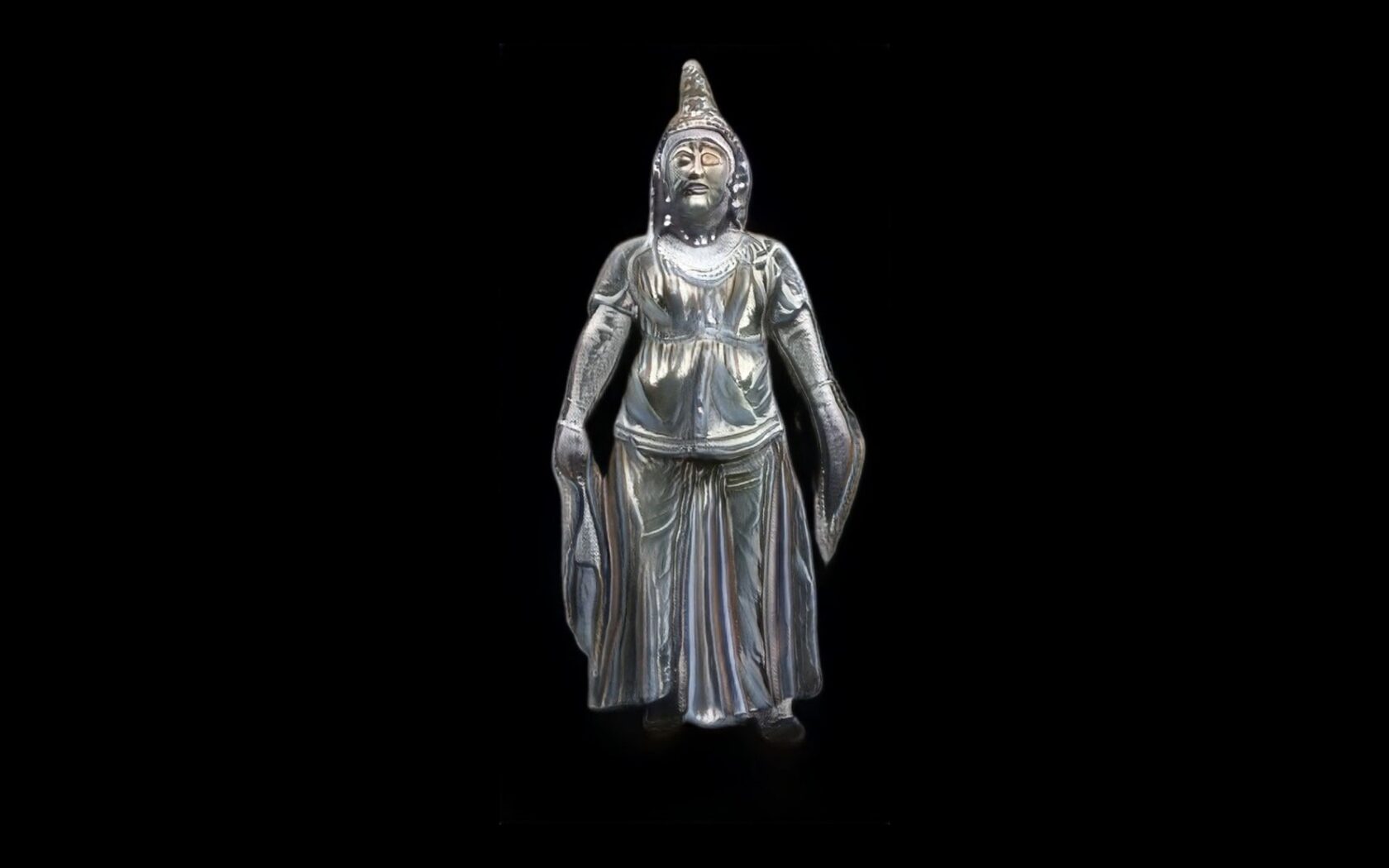
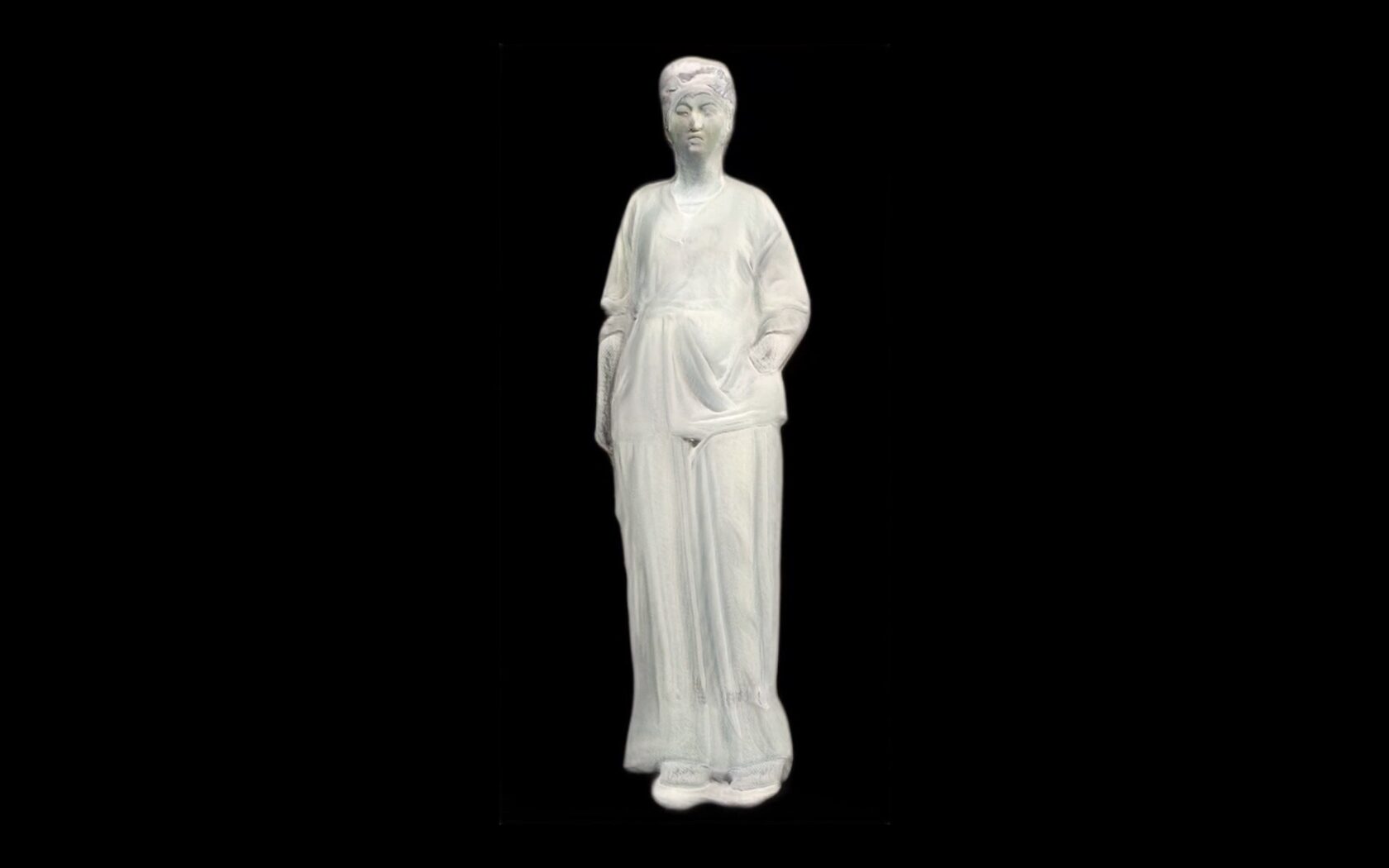
The installation harnesses three models - the visual, the audio and the language one. During the interaction, a photo of a person is taken and their voice is recorded. The background of the photo is removed and filled with black. It is then projected onto the latent space of the first model, StyleGAN2-ADA, and interpolated with images of gods from different religions and cultures. The recorded voice is cloned by the voice-cloning XTTS model. The image of the person is projected onto a fabric in the center of a darkened room. Now, one's words are transcribed by the Whisper model; LLM responds to them and the responses are vocalized by XTTS with one's own voice. At first, the image and voice are a reflection of the viewer. Over time, the image begins to morph seamlessly into figures of gods from different eras and cultures, and the voice changes beyond recognition. In the final phase, the image becomes deformed and the voice becomes anonymous, no longer resembling the voice of any known person.
The StyleGAN was trained on a dataset comprising equal parts human and deity-like silhouettes. Human images were sourced from the SHHQ Dataset, while the deity images were scraped by us, ensuring selection from sources with Creative Commons licenses. Our dataset encompasses depictions of gods from diverse cultures and religions around the world, mainly in sculptural form, with some picture representations included.
BIOS
Julia Chylak (PL) is a MSc student of Paintings at the Academy of Fine Arts in Warsaw and a MSc student of Machine Learning at the University of Warsaw. Her research focuses on video generation, especially animation. With her deep knowledge in Maths, she also tries to intertwine threads of Math Art and AI Art. Mateusz Błajda (PL) is a machine learning researcher and engineer working across multiple domains. He has experience working with audio related fields like emotion recognition, voice enhancement and speech generation models. Currently working with proteomic data, developing a model that will help in the vaccine discovery process. Eryk Imos (PL) is an MSc student specializing in theoretical physics, specifically concentrating on quantum complex systems. With experience in programming, data analysis, and conducting physical simulations, his master’s thesis investigates the application of neural networks in tunable quantum-optical systems. His interest in AI focuses on leveraging neural network algorithms to innovate perceptions, routines, and thought processes. Beata Bajno (PL) is a multidisciplinary artist and architect, actively engaged in scientific research on art perception. She explores the dynamics of creating personal models of the world and develops immersive light installations, delving into the processes of emergence, transformation and disruption of internal visual imagery. She participated in a number of exhibitions and she was a recipient of numerous awards including Prix de la Photographie Paris, International Photography Awards, Venice International Photo Contest, Warsaw Graphic print Competition. Paulina Wachnicka (PL) is a nanotechnology student with a penchant for anything aesthetic. She is fascinated both by the artistic, and the scientific perspective of the world and strives to incorporate each one of them into her own expression. With a background in physics, she employs light and colors to develop and share her vision. Her works were shown at local exhibitions In Warsaw.