
Nick Oh & Alex Park
artefact(s): LeNet-1
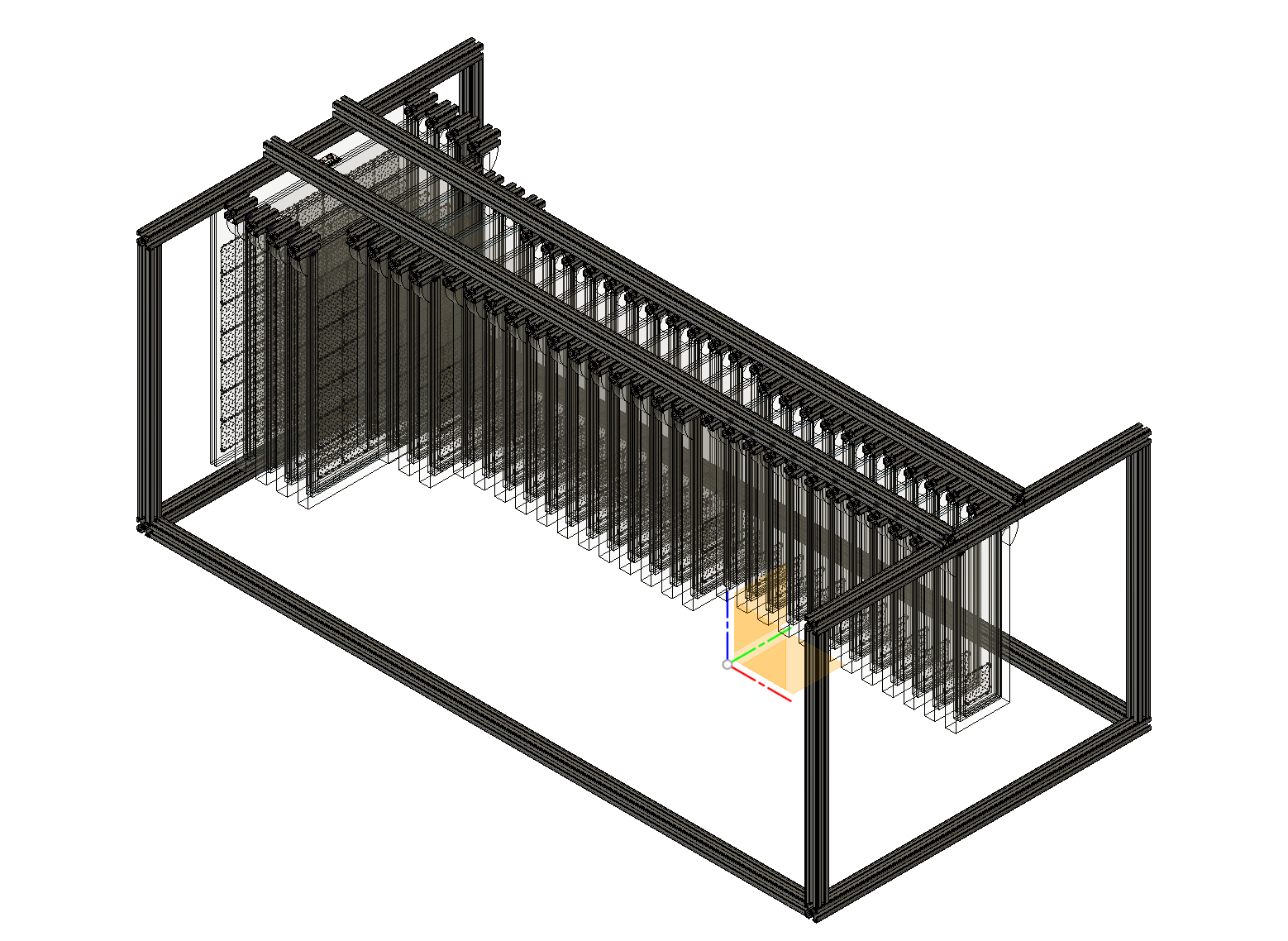
artefact(s): LeNet-1 (2026) is an act of keeping, against the way software usually disappears. Most programs are superseded, deprecated, forgotten, and leave no body behind. The work is an attempt to keep one alive long enough to be looked at. The network at its centre is real and old, one of the first convolutional neural networks that worked, built by Yann LeCun and his team at Bell Labs in 1989 to read handwritten numbers off envelopes. It still runs, and unlike most software of its age, it can still be rebuilt. But it has crossed the line that old instruments cross, from a thing judged by what it does to a thing weighed for what it meant. The installation gives that crossing a form. The network is rebuilt exactly, layer for layer, in transparent circuit boards carrying grids of individually addressable LEDs, mounted in glass and resin on rails of bare aluminium. It loops through handwritten digits and lets each one move through the structure in slow light, the activations rising and falling where a processor would have buried them. You watch a 1989 machine perceive, at a tempo a body can follow, in a room you can walk around. The title carries the doubleness on purpose. In software, an artefact is a by-product, something a process leaves behind without meaning to. In archaeology, it is the opposite, a made thing that survives its makers and is valued for what it reveals. LeNet-1 has become both, a working relic, an origin held in the present tense.

The network we physicalise is the one in the video demo, described in LeCun et al.'s NeurIPS (then known as NIPS) 1989 paper Handwritten Digit Recognition with a Back-Propagation Network. A 28×28 input, four hidden layers, ten output classes. The architecture, the layer dimensions, and the order of operations are all faithful to the original (LeCun et al., 1989, p. 401, Figure 4). To us, the installation was more interesting if what you were watching was genuinely LeNet "thinking". The only translation we allowed ourselves was a translation of substrate, of bits to atoms. We did not want a sculpture that gestures at a neural network. We wanted a neural network that happens to be a sculpture.
Yann LeCun's demo of LeNet-1 in the Adaptive System Research Department at Bell Labs
The whole structure is transparent, and yet the network keeps its secret. You can see every board, every trace, every connection, and still not see why it reads one digit as a five and another as a three. That gap, between seeing all of a thing and understanding it, is what the work leaves you with.
Forward propagation of artefact(s): LeNet-1


Nick Oh is a researcher at socius labs experimenting at the intersection between every field that ever studied "thinking" and every machine that's trying to "think". Advised by Fernand Gobet, he works across cognitive science, philosophy, and neural networks, and treats artistic practice as a continuous part of that thinking.
Alex Park is a theoretical physicist and a maker. Trained in theoretical and mathematical physics at King's College London, he can be found at socius labs whenever there's something to build, and moves between equations and electronics with no particular hierarchy between them.