Laura Wagner
Drawing ImageNet
Assembled at a specific historical moment by a situated group of contributors and filtered through the infrastructure and aesthetics of Web 2.0, ImageNet is one of the most consequential taxonomies produced by computational culture. Its 1000-class benchmark helped shape the field of computer vision and continues to influence how datasets are filtered, how computer vision tasks are posed and how models are trained, evaluated, and benchmarked. More than a technical dataset, ImageNet is also an ethnographic artefact of a mainly WEIRD society at a specific point in history, capturing a world frozen in time. The particular algorithmic lens emerging from this dataset, continues to shape contemporary computer vision, and its cultural inscription persists in the generative AI systems that inherit and reproduce it.
Alongside an emphasis on prosaic everyday objects, frequently rooted in Americana, such as football, fishing gear, barbecue equipment, and pickup trucks, ImageNet contains a myriad of classes referencing the natural world. Yet this world appears through a distinctly human lens: among its many animal categories, nearly half are different dog breeds. Rather than simply representing nature, the dataset characterizes a culturally specific human relationship to it.
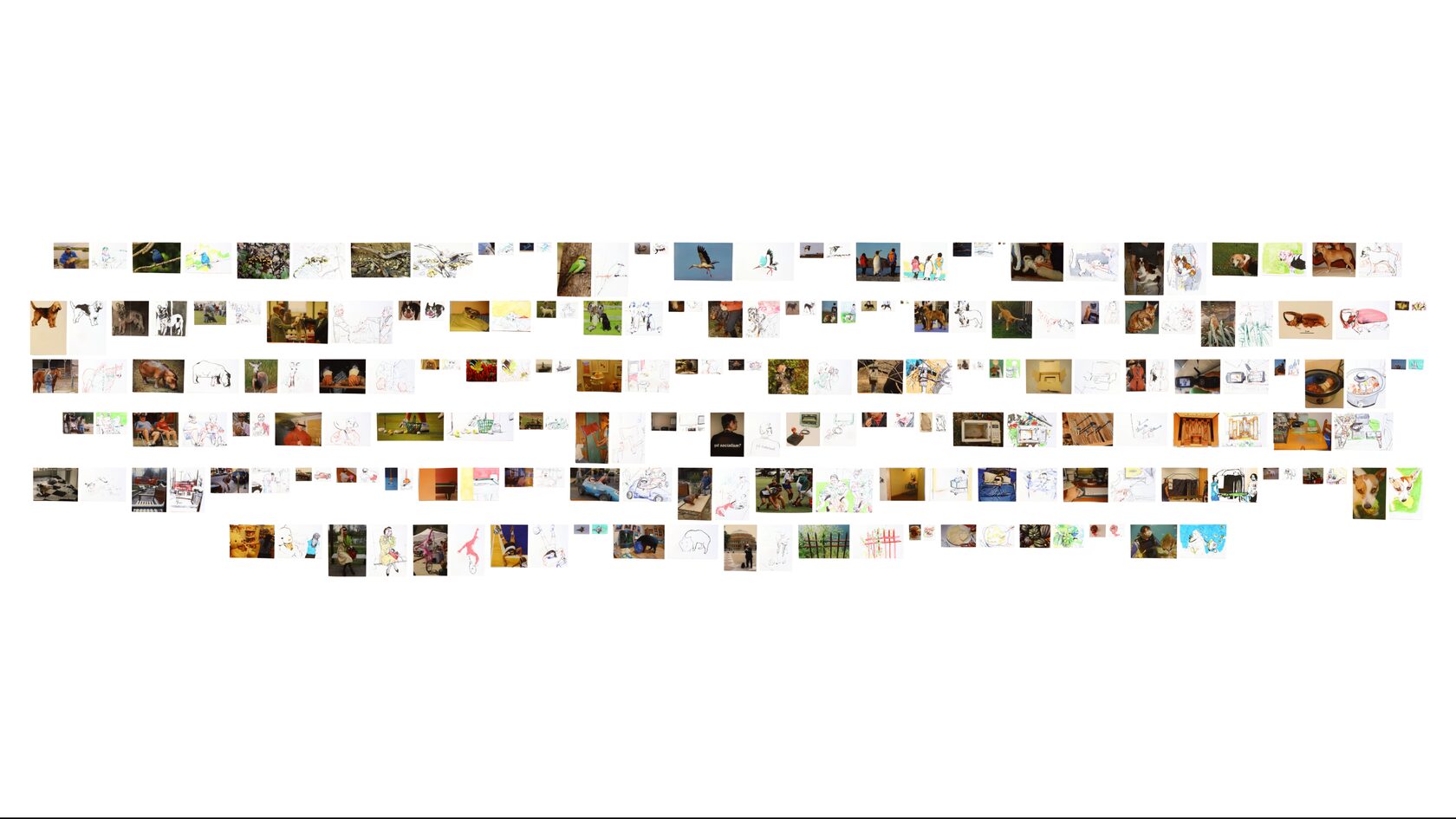
Drawing ImageNet slowly and inefficiently approaches a taxonomy that is meant to be primarily performative, for benchmarking, evaluation, and filtering, with its actual content rarely looked at, apart from data annotators with a specific and imposed task. As an exercise, Drawing ImageNet coaxes out situatedness and cultural assumptions embedded in individual images through a human lens. A script randomly selects an unvisited class from the benchmark dataset and presents a random image from within it as a drawing reference; the selection and timing spent drawing are logged, and the class is retired. One hundred classes were randomly selected an drawn this way.
The resulting drawings characterize ImageNet itself. They reveal the dataset as both systematic and idiosyncratic: sometimes absurd, sometimes charming and shaped by a distinctly narrow cultural lens. By translating algorithmic taxonomy into slow, analogue drawings, the project stages an encounter between two fundamentally different worldviews: the human tradition of art as an intentional, context-driven act, and the computational paradigm that treats visual culture as measurable, optimizable data.