
Karen ann Donnachie & Andrea (Andy) Simionato
I Don't Know What I Think Until I Read What I Write
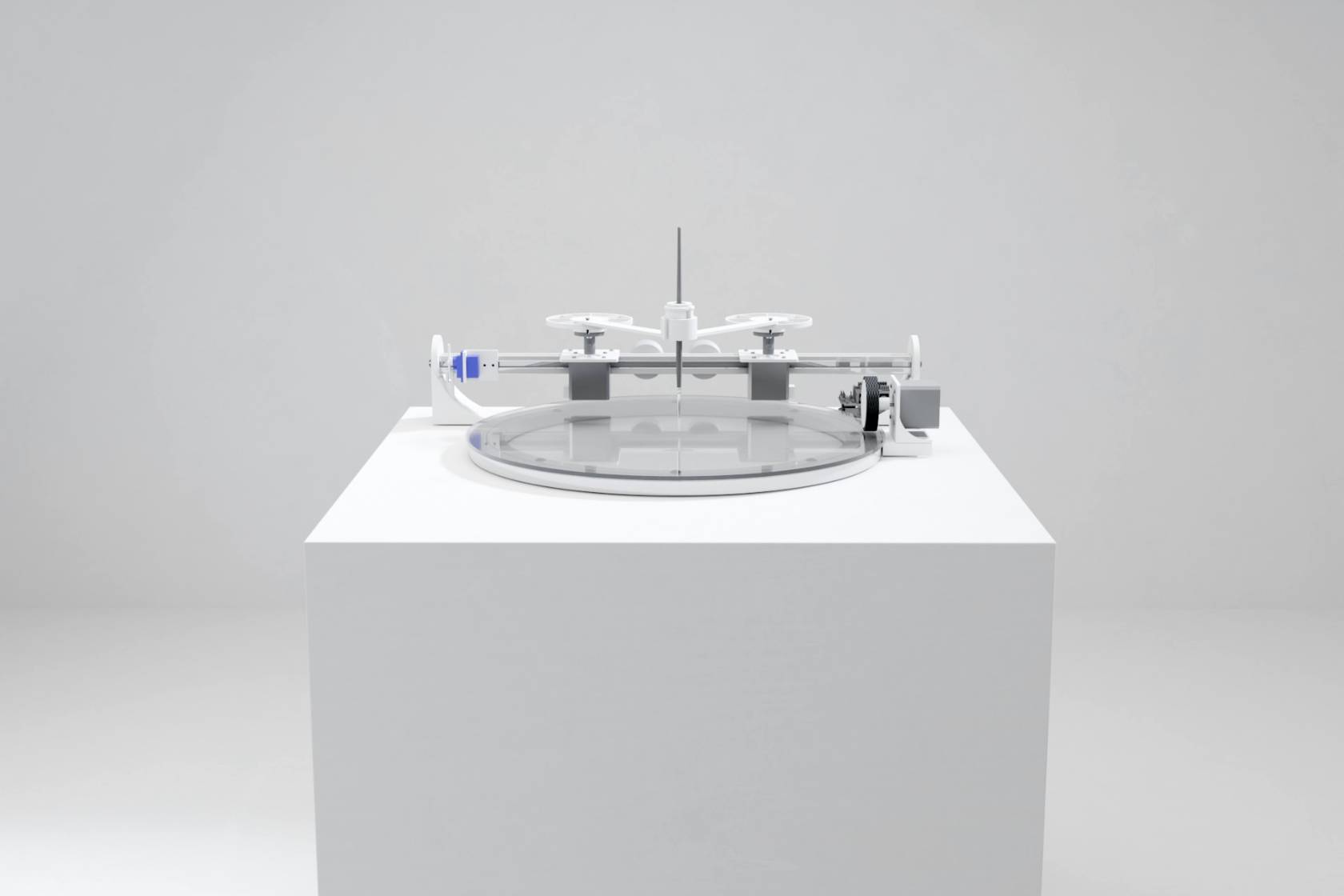
A robotic-scribe which makes meaning only AFTER it makes marks.
A robotic-scribe is programmed to 'learn' from its own mark-making, not unlike a child learns to draw by first "following the line" and then later attributing meanings and symbols to the outcomes of their drawings. The system autonomously adjusts its physical movements and evaluates (previously unforeseen) results, constantly transforming and destroying in a process of experimental exploration. Only when the system determines that a drawing has reached sufficient qualities (currently these include spatial entropy, line fluidity, complexity, or energy) it will attempt to attribute one or more meanings to it, memorising the gesture for future use in its own constantly transforming nonhuman writing system.
![I Don't Know What I Think..., [Robotic-scribe], 2025, Steel, PLA plastic, micro-controllers, electric motors, etched acrylic, horse-hair brush, Various, Karen ann Donnachie & Andy Simionato.](/images/2026/karen-ann-donnachie/art_6a102e99daef6.jpg)
I Don't Know What I Think..., [Robotic-scribe], 2025, Steel, PLA plastic, micro-controllers, electric motors, etched acrylic, horse-hair brush, Various, Karen ann Donnachie & Andy Simionato.
The robotic-scribe and its writing system.
This automated-art-system emerged from experiments with non-Euclidean drawings and typefaces. We built a 2-arm drawing-machine and designed software to operate it as a polar-coordinate mark-making system capable of executing resolution-independent gestural movements which use no segmentation of paths. The 2-arm machine and custom-coded software permits the system to leverage the rotational movements of the motors in order to closely mimic calligraphy or some styles of hand-writing.
![I Don't Know What I Think... , [overhead machine view], 2025.](/images/2026/karen-ann-donnachie/art_6a1031a0b990d.gif)
I Don't Know What I Think... , [overhead machine view], 2025.
Rather than attempting to use existing methodologies for CNC line-drawing, which typically involves calculating the inverse kinematics of a desired path and then breaking these paths into a chain of smaller movements, we designed a system which is resolution independent by privileging the affordances of what we consider the machine's "native" elliptical geometries. The result is a novel drawing system capable of solving for all available paths for any given pair of destination points within a specified manifold space using only the (non-segmented) elliptical paths made possible by the motors. Highly "looping" paths can be combined with more direct (but always non-linear) "shortest distance" paths to generate drawings. What the system may lose in accuracy (when compared to traditional CNC methods) it gains in efficiency, speed and fluidity of execution.
![Glyph generation from prototype of IDKWIT system, [IDKWIT archive tool], 2025, digital file, 1024px, Karen ann Donnachie & Andy Simionato.](/images/2026/karen-ann-donnachie/art_6a102eb485265.jpg)
Glyph generation from prototype of IDKWIT system, [IDKWIT archive tool], 2025, digital file, 1024px, Karen ann Donnachie & Andy Simionato.
How the system evaluates its outcomes.
Over the course of the first few drawing sessions, the automated-art-system generated several hundred drawings. It became evident we risked becoming overwhelmed with drawings, so we introduced a secondary "curatorial algorithm" which aims to select drawings with sufficient salience, while discarding the remainder. The system's evaluation of the drawings involves assessing its spatial entropy/harmony, flow/complexity, and efficiency/energy (or power). These criteria, which remain in flux, have been determined through the study of calligraphic traditions such as Chinese shūfǎ (書法), and Japanese shodō (書道).
![Glyph generation from prototype of IDKWIT system, [IDKWIT archive tool], 2025, digital file, 1024px, Karen ann Donnachie & Andy Simionato.](/images/2026/karen-ann-donnachie/art_6a1035dfbad06.jpg)
Glyph generation from prototype of IDKWIT system, [IDKWIT archive tool], 2025, digital file, 1024px, Karen ann Donnachie & Andy Simionato.
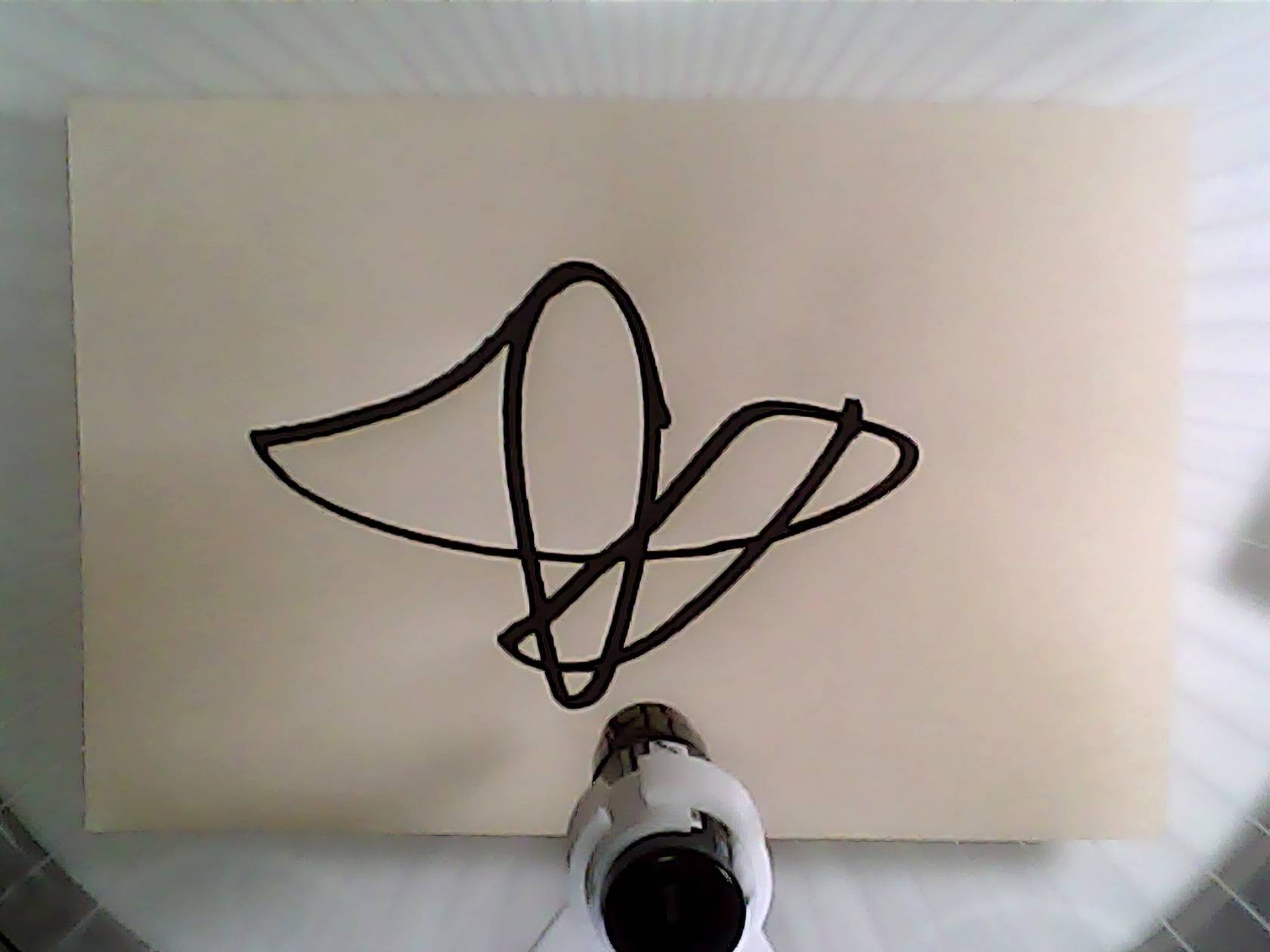
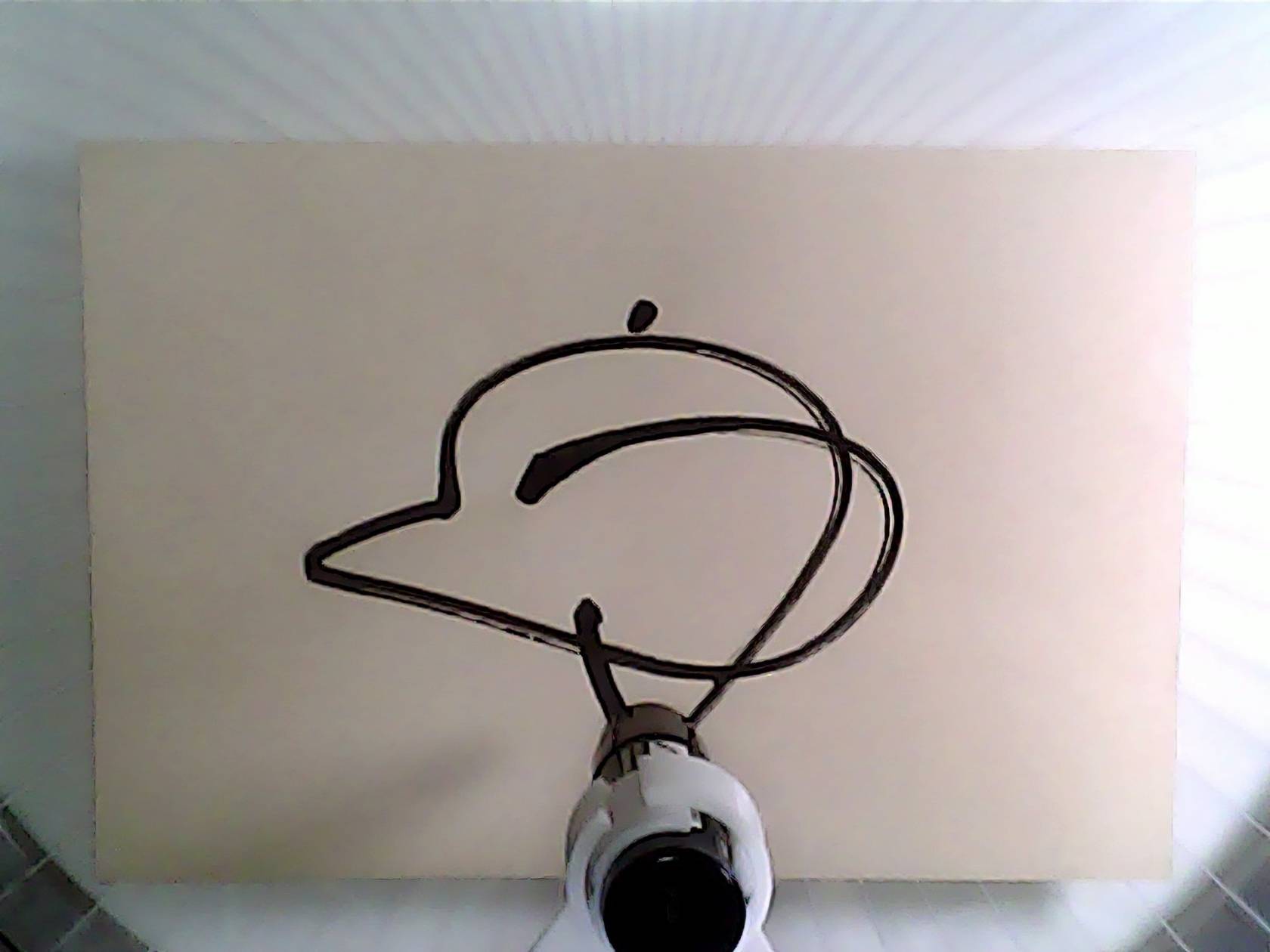
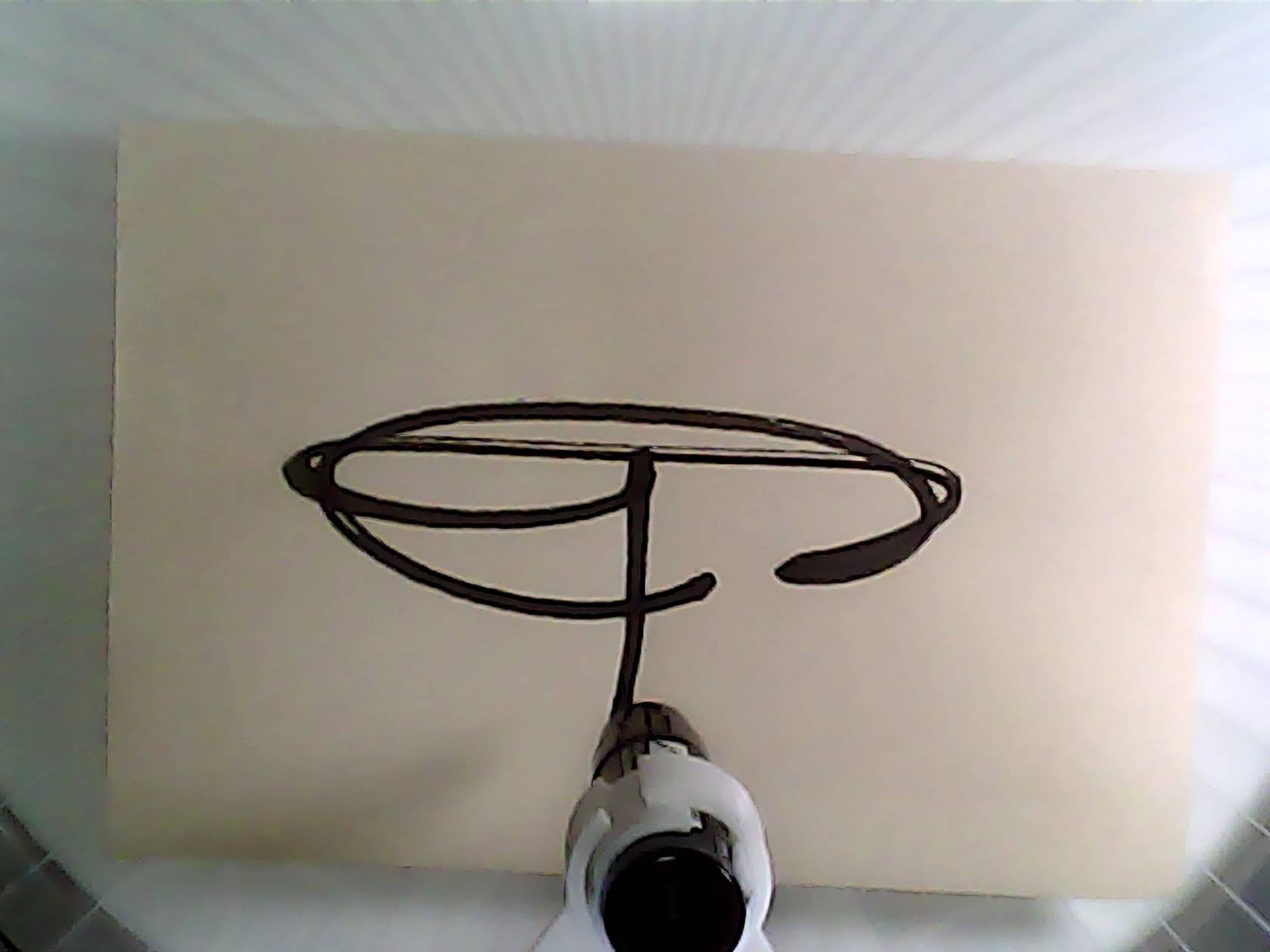
I Dont Know What I Think..., [Drawing from first prototype], 2025, Ink, Paper, 150 x 210 mm, Karen ann Donnachie & Andy Simionato.
Autopoiesis and mark/meaning making.
Once a drawing is evaluated for inclusion in the system's archive it is parsed through a third and final function which attempts to associate the drawing to one or more meanings or concepts. This process is also in constant flux, currently using a mix of Computer Vision functions and real-world environmental measurements to attribute meaning to the drawing and link it to other drawings. This database of (potential) morphemes was then reintegrated to the automated-art-system.
![I Dont Know What I Think..., [first prototypes], 2025, Ink, Paper, 150 x 210 mm, Karen ann Donnachie & Andy Simionato.](/images/2026/karen-ann-donnachie/art_6a102f443db48.jpg)
I Dont Know What I Think..., [first prototypes], 2025, Ink, Paper, 150 x 210 mm, Karen ann Donnachie & Andy Simionato.
It could be argued that the changes in behaviour we are currently observing in the robotic-scribe represents the results of intermeshing external (environmental) influences with the system's internal (programmed) impulse to draw. Will this behaviour –that appears to happen somewhere between making marks and making meaning– lead to a nonhuman writing system?
I don't know what I think, until I read what I write.
I Don't Know What I Think Until I Read What I Write, 2025
Karen ann Donnachie and Andrea [Andy] Simionato have worked together in the expanded fields of computational art, design, and post-digital publishing since the 1990s. Working across human and nonhuman collaborative systems, they make electronic art, robotic drawing machines, nonhuman collage, and The Library of Nonhuman Books. Their artworks and designs are exhibited in solo and group exhibitions internationally. They founded the Center for Computational Unknowing in 2022.