
Joonhyung Bae
Fixion
Fixion (2026)
If a diffusion model redraws a face 150 times with no prompt, where does it take that face? Fixion begins with this question.
I selected 126 demographically balanced faces from the FairFace dataset (7 races × 2 genders × 9 age groups) and ran each through 150 iterations of Flux.1-dev img2img with an empty prompt. At denoising strength 0.4, the model holds onto 60% of each input and rewrites the rest. The empty prompt is the point: with no instruction from me, what does the model do on its own?
Every one of the 126 trajectories reached a limit cycle—a state where the model keeps producing subtly different versions without ever settling. No face was finished. No two faces collapsed into one (pairwise LPIPS minimum 0.52; zero visually identical pairs). After 150 iterations the theoretical retention of the original signal is 0.6¹⁵⁰ ≈ 10⁻³³, essentially zero. The faces persist anyway. The model isn't carrying forward residue; it's reconstructing facial structure from scratch each pass, and arriving somewhere stable.
CLIP semantic space tells a different story. Some pairs that looked visually distinct sat almost on top of each other in embedding space (cosine distance minimum 0.05). Visual uniqueness and semantic uniqueness aren't the same thing. Across race, gender, and age I found no convergence bias (Kruskal-Wallis p = 0.90). Whether that reflects an absence of bias or an indifference to difference is not a question a metric can answer.
The 75-second video arranges the 126 faces in a 14×9 grid and maps 150 iterations onto time with an easing function (t^0.6). Eighteen "breaths" interrupt the progression, organized by race × gender or age blocks: the original face surfaces briefly as a translucent overlay, then fades. The eye adapts to constant transformation faster than you'd expect; the breaths return the baseline so the scale of change becomes legible again.
Sound comes from granular synthesis. Diffusion breaks images into noise and rebuilds them; granular synthesis breaks sound into 40ms grains and rebuilds those. The diversity of the 126 images at each iteration drives grain density (3–15), converging toward three but never to one. The remaining grains hold a fine oscillation alive—the audible form of the limit cycle. Reverb, delay, and chorus carry over what iterative img2img actually does: trace, feedback, drift.
The grid borrows from August Sander's Menschen des 20. Jahrhunderts. The iterative overpainting borrows from Gerhard Richter's Overpainted Photographs, with one difference: Richter decides when to stop. For this model, that decision never comes. Cage emptied the score in 4'33" so the room could be heard. Fixion empties the prompt so the model can be seen.
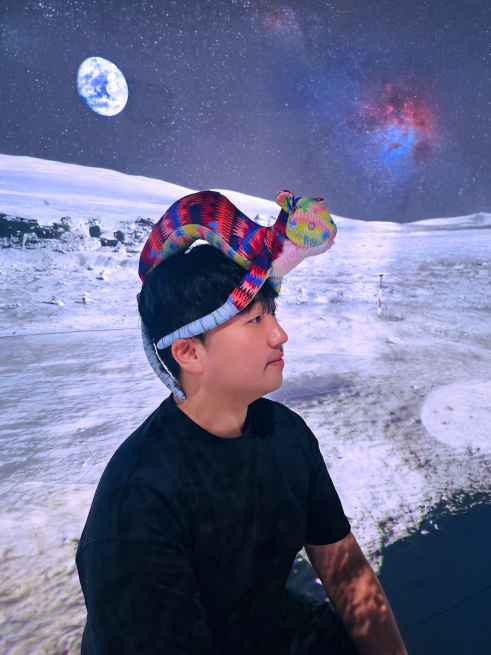
Joonhyung Bae (b. 1995) is a multimodal AI researcher and art-technology practitioner. His work examines the relationship between humans and society within technological environments, inviting audiences to encounter it through playful, embodied experience. A PhD candidate at KAIST, he has published at NeurIPS, SIGGRAPH Asia, CHI, ISMAR, ISMIR, and ISEA, and exhibited at the Asia Culture Center, the National Science Museum of Korea, and the 1st Seoul Convergence Arts Festival Unfold X.
Joonhyung Bae (b. 1995) is a multimodal AI researcher and art-technology practitioner whose work examines the relationship between humans and society within technological environments. Across games, VR, performance, and installation, he designs the rules and conditions from which narrative emerges, inviting audiences to meet that relationship through playful, embodied experience rather than explanation. He holds a BFA in Design from Korea University and an MS in Culture Technology from KAIST, where he is a PhD candidate. His technical research centers on music-conditioned motion generation, investigating how the structural and expressive properties of music map onto bodily movement. He has published at leading venues including NeurIPS, SIGGRAPH Asia, CHI, ISMAR, ISMIR, and ISEA, and has exhibited at the Asia Culture Center, the National Science Museum of Korea, the Sejong Museum of Art, the Daejeon Museum of Art, and the 1st Seoul Convergence Arts Festival Unfold X, among others.