
James Bloom
LOSS SURFACE
Physical 3D reliefs made from the landscape generated by an AI engaged in the task of perceiving the world. The surface shows the traces of millions of visual labelling procedures, made perceptible to a viewer in landscape form. Where the model fails to interpret what it sees correctly, a mountain is produced.

The act of perceiving is a long-explored theme both in art and philosophy. Here a visual recognition AI model is captured in the moment of visual comprehension, with the resulting landscape a 3-dimensional manifestation of the contours of perception, highlighting the failure to 'see' correctly.
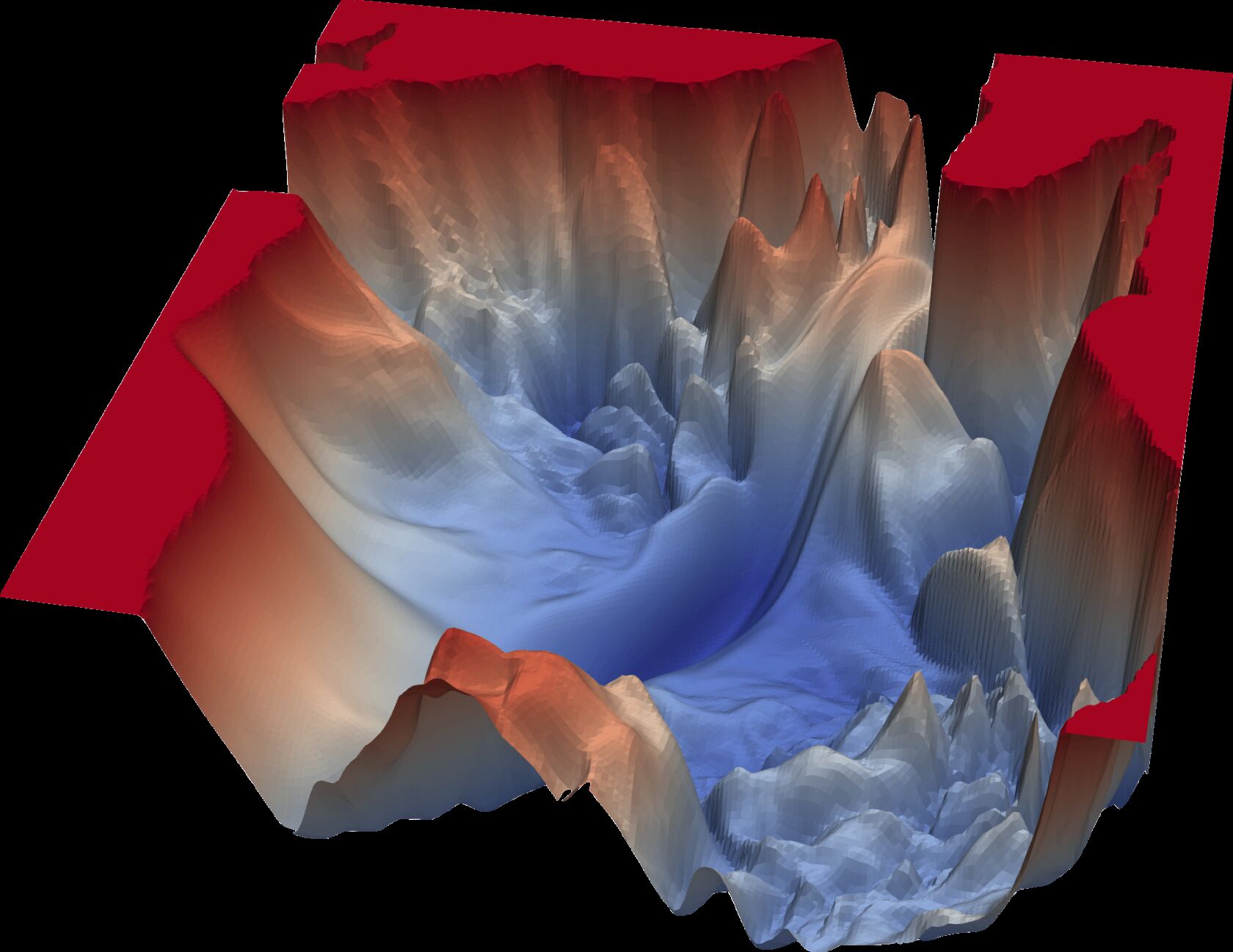
These 3D digital topographies generated from multiple AI model runs then become the material for the artwork. They are composed together in 3D modelling software and machine-carved into polyurethane. The surface of the object is painted with acrylic and clear coat, which reflects back traces of the viewer and environment. The artworks don't easily yield meaning to a viewer, but instead are records of perceptual failure.

It is said that the encroachment of machine learning into the classification of reality generates a landscape in which human agency is frustrated and alienated. It fails to capture the world we live in on our own terms. Yet these technologies are also the product of the human impulse to perceive and classify. The artworks take an invisible process and make it visible, while also demonstrating its collapse.
James Bloom uses technological innovation as a method to generate perceptual problems. He takes complex code-based and material production techniques and combines them in unintended ways, often to the point of failure, triggering new states. His software artworks change in real-time and often connect hundreds of participants online, but have functionality engineered out, upending the structure of the systems they exist within and revealing possibilities for autonomy.
He has exhibited at ZKM, the Museum of the Moving Image New York, Strouk Gallery Paris and Abu Dhabi Art among others. His works are in the permanent collection of ZKM and the Francisco Carolinum Museum.