
Atay Ilgun
Besties
Atay Ilgun
ProtoAGI Bestiary - a.k.a Besties.
2025
In the Middle Ages, natural philosophers and artists often depicted creatures without ever seeing them firsthand. Instead, they relied on textual accounts such as travelers’ tales, oral reports, and earlier compendia of knowledge to construct visual representations of animals both real and imagined. The result was a compendium of fantastical life: dragons with serpentine tails, lions with goat heads, and birds whose plumage mirrored constellations. These works were not merely decorative; they encoded cultural, moral, and epistemic narratives, embodying the intersection of imagination, speculation, and scholarly authority.
The artworks presented here are created in a strikingly analogous fashion, yet within the framework of twenty-first-century machine intelligence. Each image emerges from a large language model tasked solely with generating SVG code in response to textual prompts. Crucially, these illustrations do not draw upon any image-based datasets or visual templates; every path, gradient, and curve is constructed purely through linguistic synthesis. In other words, these are not translations of pre-existing visuals, they are entirely original visualisations conjured by the model from language alone. This approach represents a novel mode of AI creativity: a process in which textual understanding functions as the scaffold for visual imagination, yielding artefacts that are at once singular, unique, and unrepeatable.
From a conceptual perspective, these works situate themselves within a form of digital neomedievalism. They echo the epistemic conditions of medieval bestiary creation, wherein knowledge was mediated, incomplete, and culturally encoded, but they also foreground the emerging capacities of artificial intelligence to model the world in unprecedented ways. By synthesising plausible, fantastical creatures entirely from text, these models demonstrate early steps toward more sophisticated forms of artificial general intelligence {proto-AGI}, where linguistic world-models give rise to complex, richly detailed phenomena.
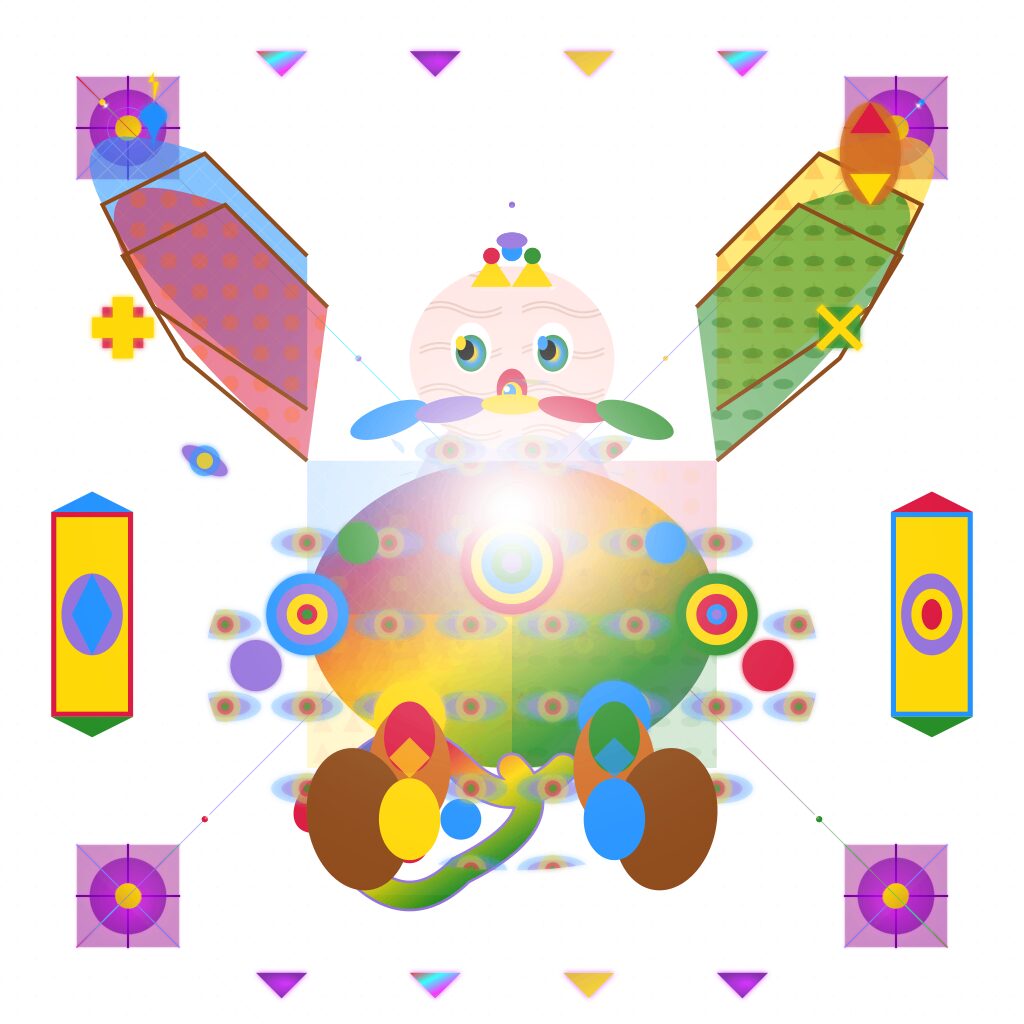
A useful contemporary parallel and inspiration for the project is the Sparks of Artificial General Intelligence essay (Bubeck et al., 2023), which argues that large language models can exhibit “general” behaviors across diverse tasks such as reasoning, abstraction, and tool-like problem solving, suggesting early, uneven “sparks” of AGI rather than a single clean threshold. In that light, these bestiary SVGs can be read as capability-traces: not just aesthetic outputs, but durable evidence of a text-based system converting linguistic world-models into structured, executable visual form. When such traces are committed on-chain, with provenance, timestamping, and immutable replayability, they begin to resemble a kind of proto-AGI material culture: artifacts that document what a model could synthesize, when, and under what prompts, in a way that can be independently verified. If future systems are recognized as more fully general, these works could be retrospectively understood as among the earliest on-chain artefacts of emergent machine imagination, a public ledger of “sparks” made legible as images.
However, a distinct evolutionary pressure separates these digital chimeras from their historical ancestors: a phenomenon we might call "Cute Accelerationism." In the medieval imagination, the sea monster survived in the cultural psyche because it was terrifying, a warning of the unknown dangers of the deep. In the latent space of the AI, however, the "scary" faces extinction. The model, trained on the aesthetic preferences of the digital attention economy, performs an act of radical aesthetic domestication. It takes the lethal, jagged concepts of antiquity, the basilisk’s gaze, the hydra’s teeth, and filters them through a lens of hyper-palatability. In this new computational reality, only the "kawaii" survives. The beast is stripped of its danger and evolved into a form optimized for memetic replication and digital collection; it is no longer a monster to be feared, but a commodity to be held.
Atay Ilgun is a London-based artist, curator, and creative technologist working across AI, blockchain, and experimental media. His practice considers how emerging technologies reshape myth, identity, and perception, drawing on cyber-folklore, machinic poetics, and reality systems.
Ilgun's Realiti (2019), one of the earliest AI artworks minted on Ethereum, was included in Sotheby's Contemporary Discoveries and is documented in The Definitive Timeline of Early NFTs on Ethereum.
Since 2020 he has curated at IKLECTIK in London. He has been supported by the British Council, presented work at CVPR and the NFT Biennial, and collaborated with DAOs. RHe has spoken at Sonar+D, Creative AI London, and UAL's Creative Computing Institute. His work has been covered by The Wire, Crack, FACT, CLOT, Resonance FM, MTV, and the BBC.
Alongside his visual practice, Ilgun is a musician and a SHAPE Platform alumnus (Creative Europe). His album EUPHORIA was released by Most Dismal Swamp in 2023, followed by a live album recorded at Cafe OTO.
In 2026 he founded soft world, a digital art studio focused on protocol art.